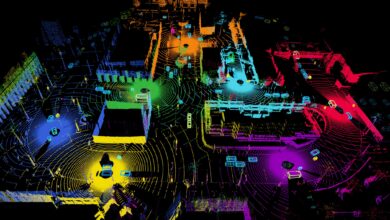
Research on traffic monitoring, object tracking, roadway understanding, and reliable edge AI.
Turning Traffic Cameras into Intelligent Sensors
Every day, traffic cameras capture thousands of images of vehicles, pedestrians, and changing road conditions. But recording a scene is very different from understanding what is happening within it. As part of a broader smart-city and intelligent transportation research collaboration with Professor Sherif Abdelwahed’s team, Swagat Das, a Computer Science Ph.D. researcher, and fellow students from Professor Milos Manic’s MHRG lab at Virginia Commonwealth University (VCU) are developing the computer vision capabilities needed to transform ordinary camera footage into meaningful traffic information.
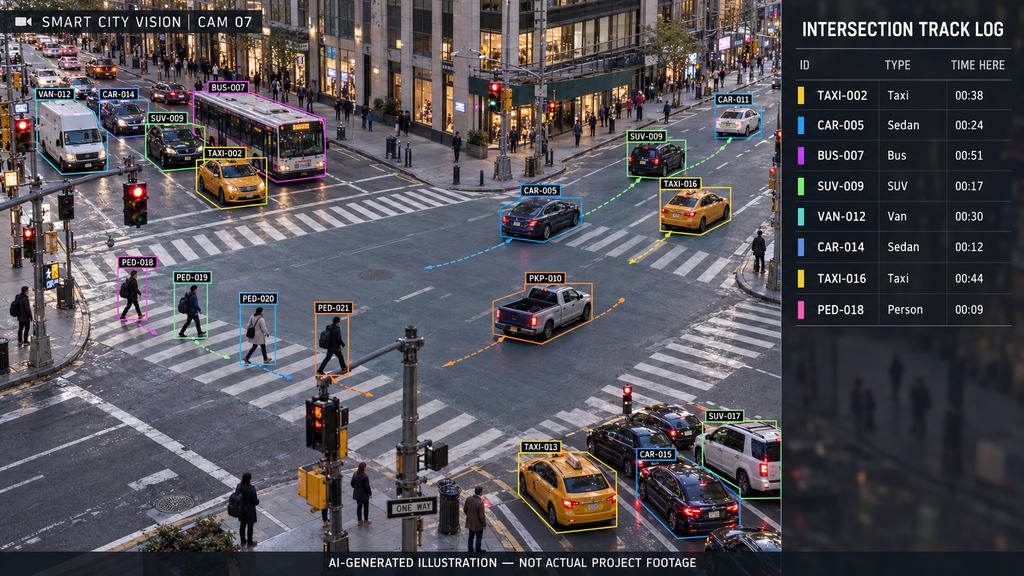
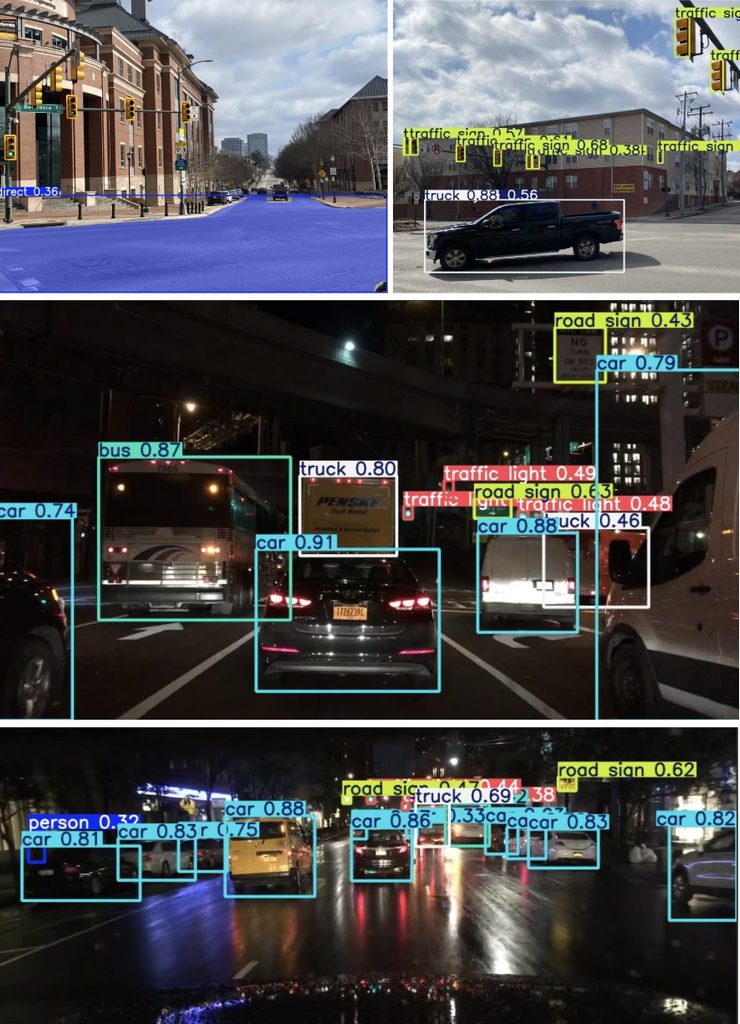
The research focuses on detecting and classifying road objects, recognizing traffic signals and their colors, identifying drivable road areas, and tracking moving vehicles across video frames. By assigning persistent identities to vehicles and analyzing their movements, the system can estimate traffic patterns, monitor vehicle activity, and measure how long individual vehicles remain visible within an intersection’s camera view. These capabilities provide valuable information for intelligent transportation infrastructure, traffic monitoring, and future autonomous driving technologies.
From Research Models to Edge Devices
The team has developed an integrated vision pipeline combining object detection, road segmentation, and multi-object tracking. The system recognizes eight categories: pedestrians, cars, trucks, buses, motorcycles, bicycles, traffic lights, and traffic signs. Additional experiments investigate traffic-light color recognition and the identification of drivable roadway regions, including demonstrations using imagery from intersections near VCU.
The drivable-area segmentation model was developed using 70,000 training images and 10,000 validation images, achieving 94.5% mean average precision at a 50% overlap threshold and 89.1% recall in controlled evaluations. The team also developed a vehicle-tracking dashboard that displays individual vehicle IDs, counts, and visible durations. In one evaluation involving 7,542 video frames, the system recorded 259 confirmed on-road vehicle tracks, demonstrating its ability to extract structured movement information from traffic footage.
To investigate practical deployment, the combined detection and segmentation pipeline was evaluated on different computing platforms. On a laboratory GPU, it processed 720p video at approximately 26.4 frames per second (FPS), with an average processing latency of 38 milliseconds per frame. On a compact NVIDIA Jetson Orin Nano, it achieved 6.9 FPS, demonstrating the feasibility of edge-based processing while highlighting opportunities for further optimization.
Making Computer Vision More Reliable and Secure
High recognition accuracy alone does not guarantee dependable performance in real-world environments. Vehicles may disappear behind obstacles, lighting and weather conditions may change, and sensors or AI models may encounter unexpected disturbances. Building on these challenges, MHRG students are investigating ways to improve object tracking through occlusions, recognize uncertain predictions, and make visual perception more adaptable to unfamiliar environments. Related research also examines vulnerabilities arising from manipulated sensor information and cyberattacks, with the aim of developing safeguards that help AI systems distinguish reliable observations from potentially misleading information.
The Role of the CCI CVN AI Testbed
The CCI CVN AI Testbed, equipped with NVIDIA H100 GPUs, provides high-performance computing resources for computationally intensive AI research. These capabilities support the broader development and evaluation of deep-learning models, large-scale visual data processing, and systematic testing across different operating conditions. The Testbed complements embedded-device experimentation by providing the computational capacity to explore more sophisticated AI models, assess their reliability, and investigate their potential for practical deployment.
Building the Foundation for Trustworthy Smart Cities
This research has potential applications in intelligent traffic monitoring, intersection safety, autonomous vehicles, advanced driver-assistance systems, and infrastructure management. The ability to recognize traffic signals, distinguish drivable surfaces, identify road users, and understand their movements represents an important building block for intelligent transportation systems.
By combining computer vision, edge computing, and research into AI reliability and cybersecurity, the team aims to develop perception systems that do more than recognize objects. They can help intelligent systems better understand movement, uncertainty, and the challenges of operating in the real world.
The ultimate goal is to help intelligent systems see more accurately, understand more reliably, and support safer decisions.